Thursday, January 2, 2014

Resoluções de Dia Novo / New Day Resolutions


É isso mesmo, dia novo, e não ano novo. Nunca fui de fazer resoluções de ano novo, a não ser, muito recentemente, aderir a uns desafios de leitura lançados pelo GoodReads no início de cada ano (não conhecem o GoodReads? Se gostam de ler, vão lá, que não se arrependem). Acho que ainda não consegui cumprir nenhum... O que reforça a minha ideia de que isto de resoluções de ano novo, não é lá grande ideia, pelo menos para mim.
Traçar objectivos a longo prazo torna-os distantes e leva-nos a adiamentos sucessivos. O primeiro adiamento começa logo na altura da resolução: muito bem, isto ainda não é para já, é só para o ano novo. O dia 1 de Janeiro, convenhamos, também não é o mais propício à implementação de novos desafios. Muitos de nós passaram a noite a festejar, deitaram-se tarde e acordam para uma casa desarrumada. Outros têm familiares ou amigos em casa, para outros, ainda, é dia de viagem de regresso. Para os que têm filhos, os primeiros dias de Janeiro são os últimos dias das férias escolares, depois vem o regresso às aulas. E por aí fora. 
 
Isto para não falar do calendário propriamente dito – porquê celebrar o início de um novo ano no dia 1 de Janeiro e não noutra data qualquer, seguindo um outro calendário (chinês, solar...).
A vida vive-se um dia de cada vez, e por isso mesmo, o que me faz sentido (e evita frustrações de resoluções e objectivos por cumprir) é procurar viver cada dia, o mais possível, de acordo com aquilo que é mais importante (e que será, inevitavelmente, diferente para cada um). Isto implica fazer escolhas, todos os dias, porque todos os dias são dias novos. Por isso:
Hoje, quando acordar antes do despertador tocar, não vou ceder à tentação de me virar para o outro lado e dormir mais um bocado. Vou-me levantar e aproveitar o silêncio e a calma das primeiras horas do dia, para tomar o pequeno almoço da maneira que mais gosto: devagar e na companhia de um bom livro;
Hoje, vou andar a pé: no campo, em redor de casa, ou na cidade, saindo 10 minutos mais cedo que o habitual e deixando o carro mais longe do destino, obrigando-me a caminhar. Se fizer isto repetidamente, acabarei por criar um hábito e a longo prazo melhorarei a minha saúde e contribuirei um pouco para um melhor ambiente, ao mesmo tempo que pouparei algum dinheiro em combustível;
Hoje, quando estiver a trabalhar, vou fazê-lo com empenho e abertura de espírito para ver tudo quanto ele tem de bom e de interessante, de que forma o posso fazer melhor e tomar nota de aspectos que gostaria de desenvolver mais, através de pesquisa ou valorização profissional. Se fizer isto de forma regular, vou ser mais produtiva e melhorar o meu currículo, o que só poderá ter boas consequências, nem que seja andar mais satisfeita comigo própria;
Hoje, quando passar pela pastelaria, vou dizer não ao bolo e ao café, e enfiar a mão no saco, onde coloquei uma fruta suculenta ou uma bolacha caseira. A longo prazo, os meus dentes vão agradecer, e a minha carteira também.
Hoje, quando me apetecer ceder à preguiça e sentar-me no sofá a olhar para a televisão, enquanto as crianças se preparam para fazer o mesmo no computador, vou convidá-las para jogar um jogo comigo, para lermos um livro em conjunto ou fazermos um cartão para um familiar que vive longe. Aos poucos, vou contribuir para o seu desenvolvimento mais saudável e fortalecer relações familiares;
Hoje, vou fazer uma lista de compras para a semana, olhando primeiro para o que temos no frigorífico e na despensa, e depois para os folhetos dos supermercados, procurando tirar partido de algumas promoções em vigor. Dá algum trabalho e requer algum tempo, mas vale a pena, pois garante uma série de refeições mais saudáveis e a preços mais convenientes, aproveitando alimentos que já existem em casa e poderiam vir a estragar-se por falta de utilização atempada.
Esta lista poderia ser mais longa, mas o importante é que esta noite, quando me for deitar, vou pensar no dia que passou e sentir-me satisfeita por ter dado mais alguns passos, mesmo que pequenos, na direcção que escolhi: uma família unida e saudável, um trabalho gratificante, um ambiente um pouco melhor e um futuro economicamente mais estável.
* * *

That's not a typo, I did mean new day, not New Year resolutions. I've never had the habit of making New Year's resolutions, except for – and only very recently - joining an annual reading challenge launched by GoodReads at the beginning of each year (you do not know GoodReads? If you like to read, go there, you'll not regret it). Well, I've never managed to meet any of these... which reinforces my idea that New Year's resolutions are not such a great idea, at least for me.


Setting long-term objectives makes them distant and unreal and leads us to repeated postponements. The first postponement starts right at the time of the resolution: this is not for now, just after the new year begins, right? ThenJanuary 1 comes, and let's face it, this is not the most adequate day for implementing new challenges. Many of us spent the night before partying, went to sleep late and woke up to an untidy house. Others have family or friends at home, still others are travelling back to their own homes. For those who have children, the first days of January are the last days of school holidays, then it's back to school time, time to re-adjust daily routines...
Not to mention the calendar itself - why celebrate the beginning of a new year on January 1
at all and not on any other date, following a different calendar (Chinese, solar ... )?


We live our lives one day at a time, and therefore, what makes sense to me (and avoids frustrations of unfulfilled resolutions and goals) is to try to live every day as much as possible, according to what is most important (which will inevitably be different for each person). This involves making choices every day, because every day is new day. This is why:


Today, when
I wake up before the alarm clock rings, I will resist the temptation to turn around to the other side and sleep some more. I'll get up and enjoy the silence and stillness of the early morning having breakfast the way I like it best: slowly and in the company of a good book (not sitting by the PC checking work-related e-mails as I often do);


Today, I
will walk: in the fields, around our home, or in town, leaving 10 minutes earlier than usual and parking the car further away from my destination. If I do this repeatedly, I will end up creating a habit and in the long-term I'll improve my health and contribute a little bit to a better environment, while saving some money at the same time;


Today,
during work time, I'll work with commitment and an open mind to see all that that my work has that is good and interesting, how I can do it better and I'll take note of things that I'd like to further develop, through research or training. If I do this regularly, I'll be more productive and improve my resume, which can only have long-term positive outcomes;


Today , when
I go through the coffee shop, I will say no to cake and coffee, and grab the yummy piece of fruit or homemade cookie I have put earlier into my bag. In the long run, my teeth will thank me, and my wallet too.


Today , when I feel like giving in to laziness and sit on the couch staring at the TV while the kids
prepare to do the same on their computers, I will invite them to play a game with me, to read a book together or make a card for a family member who lives far away. In the long term, they will grow up more balanced and family relationships will grow stronger;


Today, I
will make a shopping list for the week, looking first at what we have in the fridge and the pantry, and then at the supermarket flyers, trying to take advantage of current sales and discounts. This means some work and requires time, but I believe it is worth it because it guarantees a series of healthier meals and more convenient prices (plus less time wandering about supermarket ailes).


T
his list could be longer, but the important thing is that tonight, when I go to bed, I will look back into the day and feel satisfied for having given a few more steps, however small, in the direction I have chosen: a united and healthy family, a fulfilling job, a slightly better environment and a more economically stable future.

Sunday, December 15, 2013

Boas Festas / Merry Christmas


Com metade de Dezembro já passado e o Natal ao virar da esquina, aqui fica o meu mais recente cartão, disponível na minha loja GCU, para vos desejar umas boas festas. A relação entre as raposas e o Natal pode não ser evidente para a maioria, mas quem vive no campo habitua-se a ouvir os seus latidos agudos, ao anoitecer, quando os dias se tornam mais frios, e tem início a época do acasalamento. E é precisamente no mês de Dezembro que eles se tornam mais frequentes, prolongando-se até Janeiro/Fevereiro.

It is amazing how time flies and here we are again: half of December is already gone and Christmas is around the corner. Wishing you a Merry Christmas with my newest card available at my GCU storefront. The link between foxes and Christmas may not seem evident, but those who live in the countryside are used to listen to their calls, when the days turn colder and the mating season begins. It is precisely in December that fox calls start to be more frequent, extending until January/February.

Friday, November 8, 2013

Volunteers


Acabei de vender 110 destes cartões no Greeting Card Universe!
Sabe mesmo bem...
O cartão inclui a imagem de uma planta aquática protegida no nosso país, o trevo-de-quatro-folhas (Marsilea quadrifolia), que fotografei na piscina biológica de uns amigos nossos.
* * *
I've just sold 110 of these cards on Greeting Card Universe!
Feels great...
The card includes an original photograph of mine of a  European waterclover (Marsilea quadrifolea) taken in a biological pool of a friend.

Saturday, September 14, 2013

Conserva de Molho de Tomate / Home-made Tomato sauce preserve


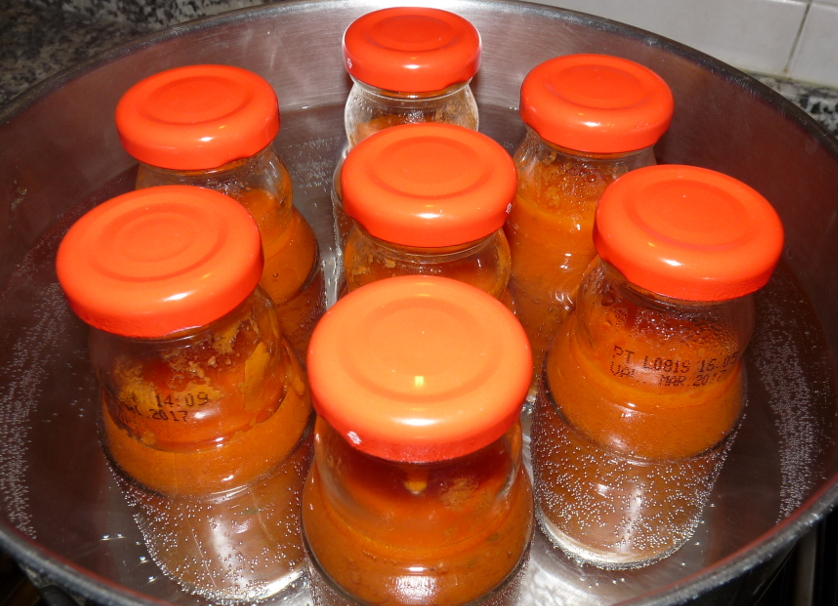
Nesta altura do ano, abundam os tomates na nossa horta. Embora este ano não esteja a ser particularmente favorável, a horta continua a produzir a um ritmo maior que aquele a que conseguimos consumir. E ainda bem, porque gosto de fazer provisão para o resto do ano, de três formas: congelando os tomates inteiros, depois de bem lavados e secos (uso-os depois para estufados e molhos), fazendo compota (este ano ainda não fiz, depois hei-de escrever sobre isso), e fazendo molho de tomate, pronto a usar, muito útil em dias atarefados, quando o tempo para cozinhar não abunda. Este molho pode ser usado como base para pizzas ou massas, para escalfar ovos (um dos meus pratos favoritos), fazer arroz de tomate, ou simplesmente adicionar um gostinho especial a uma série de outros pratos. Foi pelo molho de tomate que comecei este ano. Aqui fica a receita.

Conserva de Molho de Tomate
2 kg de tomates bem maduros
3 dentes de alho esmagados
1 folha de louro
4 folhas de mangericão
1 ramo de tomilho
2 colheres (sopa) de salsa picada
6 colheres (sopa) de azeite
1 colher (café) de açúcar
sal e pimenta

Tirar a pele aos tomates e cortá-los em pedaços.
Retirar as sementes e as partes brancas e escorrer bem.
Aquecer o alho com o azeite em lume brando, não o deixando tostar.
Juntar os tomates e restantes ingredientes, misturar com uma colher de pau e deixar ferver em lume brando durante 30 min.
Retirar o louro e o tomilho e passar tudo o resto com a varinha mágica.
Encher os frascos, previamente lavados, mas não completamente (deixar 3-4 cm sem molho) e fechar bem.
Colocá-los dentro de uma panela com água até ao nível de enchimento do tomate e aquecer até ferver (eu costumo pôr um pano no fundo da panela, pois tenho medo que os frascos estalem com a trepidação provocada pela fervura da água).
Deixar ferver em lume brando durante 1 h (se forem frascos grandes, 45 min se forem pequenos), desligar e deixar arrefecer os frascos dentro da água.
E está pronto!

* * *

At this time of the year, our garden produces large amounts of tomato. Although this one has not been a particularly favourable year for gardening, we're still getting tomatoes at a higher rate than we are able to consume. Which is actually a good thing, because I like to store my pantry until the next season comes. I do it in three ways: by freezing the tomatoes whole, after washing and drying them (I then use them in a variety of recipes and to make tomato sauce), by making tomato jam (a real treat, I haven't done it this year yet, but I will, and I'll write about it then), and by making ready to use tomato sauce preserve. This can be really useful for those busy days, when cooking time just is not available. I use this sauce for pizzas, for cooking poached eggs (one of my favourite dishes), tomato rice or simply to add a nice flavour to a variety of other dishes.
Here is the recipe.

Tomato Sauce Preserve
2kg of ripe tomatoes

3 cloves garlic, crushed
1 bay leaf
4 finely chopped leaves of fresh basil
1 sprig fresh thyme
2 spoonfuls finely chopped parsley
6 spoonfuls olive oil
1/2 teaspoon sugar
salt and pepper to taste

Peel, core and chop the tomatoes, let them drain for a while.
In a large pot, heat the olive oil and the garlic cloves, don't let them brown.
Add all remaining ingredients, mix, bring to a boil and let it simmer for 30 min.
Remove the bay leaf and thyme and blend (I use a hand blender).
Pour the hot tomato sauce into your previously washed jars (I reuse tomato sauce jars), leaving a small 3-4 cm headspace and apply lids.
Take your jars and sterilise them in a boiling water bath for 1 h (large jars) to 45 min (small jars). Turn off the heat and let the jars cool down completely inside the water.
And you're done!

Monday, August 26, 2013

Como preparar Tremoços em Casa / How to prepare Lupini beans


Há algum tempo atrás, ofereceram-me um saco de tremoços secos e ensinaram-me a prepará-los.


O grão seco do tremoço é tóxico, porque contem alcalóides neurotóxicos e hepatotóxicos, que lhe conferem um sabor amargo. Por esta razão, os tremoços só são comestíveis depois de devidamente preparados. O processo, que me foi ensinado por uma senhora que os cultiva e prepara há muitos anos, é simples:

Em primeiro lugar, escolhem-se os tremoços para remover algum que esteja estragado, ou alguma impureza. 
 
De seguida, colocam-se os tremoços de molho em água fria, de um dia para o outro, tal como se faz com o feijão ou o grão.

No dia seguinte, escorrem-se e passam-se por água limpa.

Colocam-se ao lume numa panela com água sem sal e deixam-se ferver 5-7 minutos. Quando se separarem facilmente da casca, após uma incisão com a unha (ou os dentes), sabemos que estão prontos. Não convém deixá-los cozer demasiado, pois ficariam moles.
 
Quando estiverem cozidos, retiram-se do lume, escorrem-se e colocam-se em água fria com uma mão-cheia de sal (mais ou menos 1 colher de sopa por cada litro de água).

Passadas 2-3 horas, muda-se a água e não é necessário adicionar sal.

Passadas outras tantas horas, muda-se novamente a água, colocando novamente sal.
 
Repete-se este processo 2-3 vezes por dia, durante 4 dias, até que os tremoços percam a amargura. Tradicionalmente, este processo era feito ao ar livre: os tremoços eram colocados num saco de rede debaixo de uma nascente, ou num ribeiro, fixando-se com uma pedra, e o sal era adicionado no final, após 3-4 dias deste demolhar natural.

Os tremoços mantêm-se durante várias semanas no frigorífico, num recipiente fechado, com água e uma fina camada de sal.

Os tremoços eram populares entre os romanos, que divulgaram o seu cultivo por todo o império. Hoje em dia, são um petisco comum nos países mediterrânicos e nas suas antigas colónias. Para além de Portugal, encontram-se com facilidade em Espanha, Itália, Brasil, Egipto, Síria, Líbano, Jordânia, Israel, Territórios Palestinianos e Turquia. Nos E.U.A. são populares na "Little Italy", em Chicago e no Harlem espanhol, em Nova Iorque, onde são servidos com cerveja, tal como em Portugal.

Do ponto de vista nutricional, os tremoços são um alimento bastante rico, pois possuem três vezes mais proteína e duas vezes mais fósforo do que o leite de vaca, possuindo ainda altos teores de fibra e vitaminas B e E, cálcio, potássio, ferro e omega 3.

Como se estas não fossem qualidades suficientes, o tremoceiro é também uma planta lindíssima, que fica bem em qualquer jardim e ainda por cima - porque se trata de uma leguminosa - fertiliza o solo de forma natural, ao fixar o azoto atmosférico e o transferir para o solo!


* * *


One of these days, I was offered a bag full of dry Lupini beans together with the recipe how to prepare them, so I set my hands to the task. 

The dry Lupine grain contains alkaloids that not only give it a bitter taste but are toxic as well, so they are only edible after a simple but somehow lengthy preparation. This is what I did, as instructed by an old lady that grows them herself and then prepares them like this since very long ago:

First I picked over the beans to remove any debris. 
 
Then I let them soak overnight.

The following day, I drained and rinsed them. 
 
Then I put them in a big pot of water, brought it to a boil and let the beans simmer for 5-7 minutes. I knew they were ready when I was able to easily pop a seed out after making a small incision with my nail in the skin of a bean and squeezing it between my fingers. You don't want to let them boil too long, otherwise they will get too soft.

At this point, I removed the beans from the heat, poured out the hot water and rinsed them well with cold water.

Then I put the beans in a large bowl, added a generous amount of salt (about 1 tablespoon per quart of water) and filled the bowl with water. 

After 2-3 hours, I drained, rinsed well, covered with new unsalted water and refrigerated the beans.
 
After another 2-3 hours I repeated the process, this time adding salt again.

I repeated this process 2-3 times per day for 4 days, until the soaking brine was no longer bitter (traditionally, this process was done outdoors, the beans kept in a mesh bag held with a stone under a natural spring or stream, salt being added after 3-4 days under running water). 


Beans will keep for weeks, covered with lightly salted water and refrigerated.
To serve as a snack, we just have to drain the desired quantity of beans, and eat them! They can also be served with a drizzle of olive oil and freshly ground black pepper. You can eat them by making a small tear in the skin with your teeth and popping the seed directly into your mouth, or you can just eat them with the skin on.

Beware: failure to properly remove alkaloids from lupini beans can lead to lupini toxicity, so you want to make sure all bitterness has been removed from your beans before you start eating them!

Lupins are a popular appetizer in Portuguese bars, usually served with beer. They are commonly found in markets and supermarkets, sold in bulk or in jars. 

Lupini beans were popular with the Romans, who spread their cultivation throughout the Roman Empire. It is no surprise that today, Lupini are most commonly found in Mediterranean countries and their former colonies, especially Portugal, Italy, Brazil, as well as Egypt (where it is part of Sham El Nessim holiday meals), Syria, Lebanon, Jordan, Israel, Palestinian Territories and Turkey. In the US, they are popular in Chicago's Little Italy and in New York City's Spanish Harlem, where they are served with beer, just like we do in Portugal.

From the nutritional point of view, Lupini beans are very rich, as they have three times more protein and two times more Phosphor than cow’s milk. Lupins are also high in fibre, vitamins B and E, Calcium, Potassium, Iron and Omega 3.

As if this was not enough, the lupine plant has a wonderful flower that makes a great garden addition and because it belongs to the legume family, it is a natural soil fertiliser, as it is capable of nitrogen fixation!

Saturday, August 10, 2013

Vida nova na Piscina Biológica / New Life in the Biological Pool


Em finais de abril, numa manhã solarenga mas ainda fresca, fomos surpreendidos por um novo visitante na nossa piscina biológica. Ao abrir a janela, por volta das 7h30, o L. viu uma galinha-d'água (Gallinula chloropus), não... duas galinhas-d'água! Entravam e saiam da água, ora nadando e procurando comida nas margens, ora bicando a erva na zona em redor da piscina. Corremos a buscar a máquina fotográfica e com mil cuidados, abrimos uma nesga da janela para as fotografar.
A galinha d'água é uma espécie bastante comum em Portugal, podendo ser observada tanto em lagoas e albufeiras de grande dimensão, como em lagos, parques e jardins de zonas urbanizadas. Mas foi a primeira vez que a observámos na nossa piscina!

Trata-se de uma espécie fácil de identificar através do corpo escuro, fronte e bico vermelhos com a ponta amarela, e patas claras. As penas da zona inferior da cauda são de um branco bastante conspícuo, como se pode ver na fotografia lá de cima. Apesar disso, esta espécie pode ser bastante discreta, pois é cautelosa e desloca-se frequentemente ao longo da vegetação das margens. Alimenta-se de uma grande variedade de material vegetal, bem como de pequenos animais aquáticos.

Manhã após manhã, ao abrir a janela, as galinhas lá estavam, até que se tornou uma rotina vê-las a nadar calmamente por entre os nenúfares, mas sempre alerta, escondendo-se ao menor ruído. Até que um dia, deixámos de as ver! Passou um dia, dois, três... e as galinhas sem aparecer. Foram-se embora... pensámos com pena.

Mas numa bela manhã de Maio, eis que as belas aves estavam de regresso e... acompanhadas! Afinal não se tinham ido embora, estavam, isso sim, a nidificar e agora regressavam com duas pequenas crias!

As galinhas de água que visitaram a nossa piscina foram muito silenciosas, como convém a quem uma prole a proteger, mas se quiserem escutar o seu chamamento, basta clicar aqui.
* * *

In the last days of April, on a sunny but still cool morning, we were surprised to see a Common Moorhen (Gallinula chloropus) in our biological swimming pool. My husband went to open the window, around 7h30 and there it was, this beautiful bird happily swimming around. But wait... it was not one, there were two of them! They went in and out of the water and we carefully opened a tiny bit of the window to take a few pictures.

Day after day,  when we opened the window, there they were. It became a routine to watch them every morning, swimming around confidently but totally alert and hiding at the faintest sound. Until one day... they just vanished! Each morning we peaked at the window hoping to see them, but they were nowhere to be found. They're gone... we thought a bit sad.

But on a beautiful May morning, when we were no longer expecting it, there they were again! Only this time there were not two of them, but four! Two cute chicks were following their mama everywhere, swimming behind her, walking clumsily on top of the water lilies, stopping to beg for food... We don't get tired of watching (and photographing) them!


These moorhens have so far been very silent - no wonder, because they have brood to protect. But if you want to know the sound of their call, you can listed to it here.

Sunday, July 28, 2013

Leituras de Fim-de-Semana: A Bolsa ou a Vida / Weekend Reads: Your Money or your Life


cartoon by Cal Grondahl from the book The Network Marketing Game, 1997 by Jon M. Taylor

Conhecem aquela sensação de começar a ler um livro e encontrar imensas coisas que vão exactamente de encontro aquilo que pensamos desde há muito tempo, mas que nunca tínhamos conseguido pôr em palavras? Ou até tínhamos, mais ou menos (tal como eu fiz aqui, a propósito do valor monetário que podemos atribuir ao nosso tempo), mas de uma forma muito mais rudimentar e menos elaborada?

Bom, isto é exactamente o que me está a acontecer com o livro que estou agora a ler - Your Money or Your Life (que não consegui encontrar em português, mas julgo que podíamos traduzir como "A Bolsa ou a Vida"), de Vicki Robin e Joe Dominguez.


O que é curioso é que, se eu tivesse pegado neste livro numa livraria, teria certamente voltado a poisá-lo no expositor depois de uma vista de olhos à capa e não voltaria a pensar mais nele. É que a capa está cheia daquelas frases do tipo "como deixar de ter dívidas e começar a poupar", "reordene as suas prioridades materiais e viva melhor por menos dinheiro", etc. Em suma, um típico livro de auto-ajuda sobre finanças pessoais, que não é um tema que me interesse particularmente.

Mas felizmente, eu já tinha lido acerca deste livro em vários sítios (como por exemplo este aqui) e sabia que é um dos casos em que não se deve julgar o livro pela capa. É que lá dentro discutem-se assuntos bem mais interessantes, tais como os conflitos interiores entre os nossos valores pessoais e o estilo de vida que levamos na prática, ou a avaliação das nossas despesas à luz do nosso "propósito de vida", sendo que este propósito implica mais do que trabalhar para atingir um objectivo (reformar-se aos 50, por exemplo) ou adquirir um bem há muito desejado (digamos, comprar uma casa).

A propósito dos  diferentes tipos de motivações que podem estar na base das nossas acções, gostei muito da fábula dos três pedreiros, que desbastavam um grande bloco de pedra, e que ilustra os três tipos de motivação para o trabalho mais frequentes - trabalhar para atingir um objectivo, trabalhar por atribuição de um significado e dedicação:

Um passeante aproxima-se do primeiro pedreiro e pergunta, "Desculpe, o que é que está a fazer?" O pedreiro responde asperamente, "Não está a ver? Estou a desbastar este pedregulho." Aproximando-se do segundo homem, o nosso curioso passeante faz-lhe a mesma pergunta. Este homem olha-o com um misto de orgulho e resignação e diz, "Bem, estou a ganhar a vida para sustentar a minha mulher e os meus filhos." Passando para o terceiro trabalhador, o passeante pergunta mais uma vez, "E você, o que está a fazer?" O terceiro pedreiro volta-se para o visitante, com o rosto a brilhar, e diz com reverência, "Estou a construir uma catedral!"
Moral da história: o significado que atribuímos a uma acção tem origem no nosso interior e não na acção propriamente dita.

Na minha opinião, é um livro de leitura obrigatória, com excelentes conselhos práticos que nos ajudam a olhar para a forma como gastamos o nosso dinheiro como um reflexo da maneira como vivemos as nossas vidas, avaliar se essa é realmente a forma como as queremos viver, e agir em conformidade. O mais provável é virmos a descobrir que andamos a gastar mais do que julgamos valer a pena em coisas que não trazem valor acrescido às nossas vidas, e se calhar poderíamos gastar mais noutras que nos colocariam num caminho mais directo ao nosso propósito de vida. Acho que ao fazer-nos ver o poder e o valor (do ponto de vista financeiro) de nos livrarmos daquilo que é menos importante nas nossas vidas, este livro se pode considerar uma espécie de guia de finanças pessoais em versão para minimalistas.

Tanto quanto consegui apurar, o livro não está traduzido em português, eu comprei-o na versão inglesa e posso dizer que é de leitura bastante fácil - o inglês é simples, sem floreados e acessível.

Entretanto, já enviei um e-mail a uma editora portuguesa a sugerir que o traduzam - para além deste período me parecer propício à publicação deste tipo de livros, acho que é daqueles que vale a pena divulgar, pois pode, realmente, ajudar a fazer as pessoas adoptarem uma perspectiva diferente em relação ao modo como vêem as suas vidas e tentar mudar para melhor. Não sei se a editora vai dar alguma importância ao meu e-mail, mas acredito no poder dos leitores consumidores. Pouco a pouco, vamos construindo catedrais...

* * *

Do you know the feeling when you start reading a book and find in writing many things you've been thinking to yourself, but some of them you've never been able to put into words before, and others you sort of did put them into words (like I did here regarding the attribution of a price to our time) but that book just takes them to a higher level? Well, this is exactly what is happening to me with Vicki Robin and Joe Dominguez Your Money or Your Life, that I am currently reading.

The funny thing is, if I had picked up this book on a bookstore, I've probably put it down after looking at the cover and not give it a second thought. That's because it boasts about teaching how to get out of debt and develop savings,  reorder material priorities and live well for less, etc. In summary, a typical self-help book about personal finances, something that is not in my immediate range of interests.

Fortunately, I had read about this book before (here, for instance) and knew that it discusses things way more interesting and thought provoking, such as inner conflicts between values and lifestyle and evaluating our expenditures in light of our "life purpose", being that "life purpose" is more than simply achieving a goal (retire by 50, for instance) or acquiring some longed-for possession (e.g. buy a house).

I loved the tale about the three stonecutters, each chipping away at a large block, that illustrates  the three most common kinds of purpose - goal, meaning and dedication:

A passerby approaches the first stonecutter and asks, "Excuse me, what are you doing?" The stonecutter replies rather gruffly, "Can't you see? I'm chipping away at this big hunk of stone." Approaching the second craftsman, our curious person asks the same question. This stonecutter looks up with a mixture of pride and resignation and says, "Why, I'm earning a living to take care of my wife and children." Moving to the third worker, our questioner asks, "And what are you doing?" The third stonecutter looks up, his face shining, and says with reverence, "I'm building a cathedral!"
Moral of the story: the meaning we give to an action comes from within us, not by the action.

Back to the book, it really has great practical advice that helps us look at our spending as a reflection of how we're living our lives, judge whether this is the way we really want to be living them and then, act accordingly. Chances are, we'll find we're spending way more than we think is worth on things that don't bring value to our lives and we're might be spending less on others that would put us in a path more aligned with our life purpose. I guess I could say that by showing us the financial value of getting rid of the things that are less important in our lives, this book is a sort of minimalist version of personal finances. By all means, a must read.

Meanwhile, I sent an e-mail to a Portuguese publisher suggesting they translate it - the crisis period we are going through couldn't be more appropriate. I don't know if the publisher will pay any attention to my suggestion but I believe in the power of readers consumers to change things for the better. Little by little, we can build cathedrals...